Today's
EarthStation1.com 15% (Or More!) Off Commemorative Memorial Title:
Gimme That Old Time Thanksgiving! Holiday Films MP4 Video Download
DVD
Today, November 23, 2026
November 23: National Eat A Cranberry
Day: -- An annual encouragement for the Thanksiving season for us
to take a bite of the bright red cranberry - but brace yourself
Found in acidic bogs throughout the cooler regions of the northern
hemisphere, cranberries are a group of evergreen dwarf shrubs, or
trailing vines, that grow up to 7 feet long and 8 inches high.
Their stems are slender and wiry, and they have small evergreen
leaves. The cranberry flowers are dark pink with very distinct
reflexed petals, leaving the style and stamens fully exposed and
pointing forward. The fruit of the cranberry plant is a berry that
is larger than the leaves and is initially white but when ripe,
turns a deep red. Cranberries' acidity overwhelms their sweetness.
They're a major commercial crop in Massachusetts, New Jersey,
Oregon, Washington, and Wisconsin. Wisconsin leads in cranberry
production with over half of U.S. production. We mostly find
cranberries processed into products such as juice, sauce, jam, or
sweetened dried cranberries. Cranberry sauce is considered an
indispensable part of a traditional American Thanksgiving meal.
Due to their nutrient content and antioxidant qualities, raw
cranberries are marketed as a superfruit. There are three to four
species of cranberry, classified into two sections. Producers make
white cranberry juice from cranberries harvested after they've
matured but before they turn their characteristic dark red color.
Some producers make cranberry wine in the cranberry-growing
regions of the United States. Laboratory studies indicate that
extracts containing cranberry may have anti-aging effects. The
word cranberry comes from "craneberry"; first named by
the early European settlers in America who felt the expanding
flower, stem, calyx, and petals resembled the neck, head, and bill
of a crane. Also, the word "cran" means "nerve"
in French, the nationality and heritage of many European settlers.
Anyone celebrating this holiday will need to incorporate
cranberries with other foods. Since cranberries have such a
pungent flavor, they hold their own when baked, sauteed, boiled,
blended, or pureed. This list will give you ample opportunity to
eat a cranberry and explore a variety of ways to enjoy them, too!
Bake them. Try a Cranberry Lemon Scone recipe! The sweet and tart
combination will be a perfect start to your morning. Get your
health kick-started. A Cranberry Smoothie may not meet the
definition of "eat a cranberry" but we'll let it slide -
it's too good to pass up! Add sun-dried cranberries to your
oatmeal, yogurt, popcorn or trail mix. The tart berries will offer
a morning or mid-day pick-me-up that traditional snacks don't. It
might also put you in a holiday mood. Bring cranberries to the
savory side by making a marinade. Share all your favorite ways to
enjoy a cranberry and use #EatACranberryDay to post on social
media! On Sale Until Midnight Tonight PT!
https://store.earthstation1.com/gimme-that-old-time-thanksgiving-holiday-films-mp4-video-download-dvd.html
Today's
EarthStation1.com 15% (Or More!) Off Commemorative Memorial Title:
TV Commercials: The Cable Age Classics Vol. 5 MP4 Video Download
DVD
Today, November 23, 2026
November 23: National Cashew Day: --
Celebrated annually all around the United States, this
kidney-shaped nut isn't just loved in the United States, it is
also popular around the globe. They have innumerable uses - snack
on them, cook with them, and even get drunk off of them! Cashews
are indeed elite nuts that deserve a day to celebrate them.
National Cashew Day is that special day dedicated to enjoying the
crunchy, savory, and versatile nut in many ways. The name 'cashew'
comes from the Portuguese for its fruit, 'caju' or 'acaju,'
derived from the Tupian word 'acaju,' which means 'nut that
produces itself.' Cashews, unlike other nuts, grow like tails out
of the bottom of cashew apples. Their trees are generally huge,
but Natal, Rio Grande do Norte, Brazil, is home to the world's
largest cashew tree, which covers more than 81,000 square feet,
almost 70 times the size of a regular one! The outer covering of
the cashew nut contains an anacardic acid that causes skin
irritation, which is why when Europeans first discovered cashews
in Brazil in 1558, they thought they were inedible. The
Tupi-Indians, a local native tribe, showed the Portuguese the
value of the actual seed, which they had discovered while watching
the local capuchin monkeys. They trained the Portuguese to roast
the seeds to get the irritant off. Not only did they come to enjoy
the taste of cashews, they even made wine out of its fruit's pulp.
The Portuguese were such fans of the nut that their missionaries
brought cashews to Goa, India, in 1560. The Indian climate proved
the perfect fit to plant them, and cashews took the country by
storm. Indians even discovered healing properties within the nut,
adding to its popularity. Cashews spread rapidly through Southeast
Asia and Africa and became essential parts of their food and
commerce. It wasn't until 1905 that cashews reached the United
States. They initially saw a slow spread, only becoming popular
around the mid-1920s when the General Food Corporation began
regularly shipping cashews to the U.S. and Europe. Once Americans
got a taste of it, the demand for cashews spiked. By 1941, about
22,046.23 tons were imported from India annually. Research has
shown that these nuts are effective antidepressants. They are rich
in minerals and vitamins and a perfect ingredient for soups,
stews, desserts, especially in Latin American and Asian cuisine.
Other parts of the main plant, including the fruit, oil, pulp,
bark, are just as valuable. On Sale Until Midnight Tonight PT!
https://store.earthstation1.com/tv-commercials-the-cable-age-classics-vol-5-mp4-video-download-dvd.html
Today's
EarthStation1.com 15% (Or More!) Off Commemorative Memorial Title:
Greek Fire: Ancient Greece In Today's World TV Series DVD, MP4,
USB
Today, November 23, 2026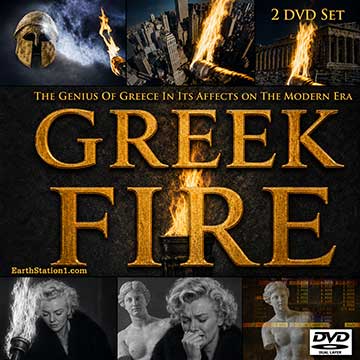
November 23, 534 BC: Aesthetics:
Performing Arts: Theatre: Acting: The History Of Acting: --
Thespis of Icaria becomes the first recorded actor to portray a
character onstage. He was, according to Ancient Greek sources and
especially Aristotle, the first person ever to appear on stage as
an actor playing a character in a play (instead of speaking as him
or herself). In other sources, he is said to have introduced the
first principal actor in addition to the chorus. Thespis was a
singer of dithyrambs (songs about stories from mythology with
choric refrains). He is credited with introducing a new style in
which one singer or actor performed the words of individual
characters in the stories, distinguishing between the characters
with the aid of different masks. This new style was called
tragedy, and Thespis was the most popular exponent of it.
Eventually, in 534 BC competitions to find the best tragedy were
instituted at the City Dionysia in Athens, and Thespis won the
first documented competition. Capitalising on his success, Thespis
also invented theatrical touring; he would tour various cities
while carrying his costumes, masks and other props in a
horse-drawn wagon. He therefore is the creator of acting. On Sale
@ 15% Off Discount Till Midnight PT!
https://store.earthstation1.com/greek-fire-ancient-greece-in-the-modern-era-tv-documentary-series.html
Today's
EarthStation1.com 15% (Or More!) Off Commemorative Memorial Title:
Timeline Middle Ages TV Newscast Series + Bonus MP4 Video Download
DVD
Today, November 23, 2026
November 23, 1248: The History Of Spain:
The Reconquista (Spanish: "Reconquest") (The Reconquest
Of Al-Andalus): The Siege Of Seville: -- The Christian forces of
King Ferdinand III Of Castile succeed in their 16-month military
investment (the military process of surrounding an enemy fort or
town with armed forces to prevent entry or escape) of the
Andalusian town of Seville in southern Spain. It is situated on
the lower reaches of the River Guadalquivir, in the southwest of
the Iberian Peninsula. Although eclipsed somewhat in geopolitical
importance by the rapid capture of Cordoba in 1236, an event which
sent a shockwave through the Muslim world, The Siege Of Seville
was nonetheless the most complex military operation undertaken by
Fernando III. It was also the last major operation of the Early
Reconquista, and also marked the first appearance of military
significance of indigenous naval forces of Castile-Leon; in
effect, Ramon de Bonifaz was the first admiral of Castile,
although he never held an official title of that kind. On Sale
Until Midnight Tonight PT!
https://store.earthstation1.com/timeline-tv-series-on-the-middle-ages-in-tv-newscast-format-2-dvd-se2.html
Today's
EarthStation1.com 15% (Or More!) Off Commemorative Memorial Title:
The American Documents: The Legendary West w Ben Johnson DVD
Download
Today, November 23, 2026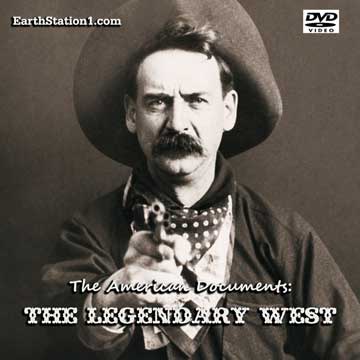
November 23, 1859: #BOTD: Billy The Kid,
also known as William H. Bonney, American Old Wild West outlaw
gunfighter (d. July 14, 1881) is #born Henry McCarty in New York
City on either September 17 or November 23, 1859. He killed eight
men before he was shot and killed at age 21 by Pat Garrett outside
Fort Sumner on July 14, 1881. He took part in New Mexico's Lincoln
County War, an Old West conflict between rival factions, which
began in 1878, in New Mexico Territory, the predecessor to the
modern state of New Mexico, and dragged on until 1881. During that
time, he allegedly took part in three murders. McCarty was
orphaned at age 13. The owner of a boarding house gave him a room
in exchange for work. His first arrest was for stealing food at
age 16 in late 1875. Ten days later, he robbed a Chinese laundry
and was arrested, but he escaped only two days later. He tried to
stay with his stepfather, and then fled from New Mexico Territory
into neighboring Arizona Territory, making him both an outlaw and
a federal fugitive. After murdering a blacksmith during an
altercation in August 1877, Bonney became a wanted man in Arizona
Territory and returned to New Mexico, where he joined a group of
cattle rustlers. He became a well-known figure in the region when
he joined the Regulators and took part in the Lincoln County War.
In April 1878, the Regulators killed three men, including Lincoln
County Sheriff William J. Brady and one of his deputies. Bonney
and two other Regulators were later charged with killing all three
men. Bonney's notoriety grew in December 1880 when the Las Vegas
Gazette in Las Vegas, New Mexico, and The Sun in New York City
carried stories about his crimes. Sheriff Pat Garrett captured
Bonney later that month at Stinking Springs, New Mexico. In April
1881, Bonney was tried and convicted of the murder of Brady, and
was sentenced to hang in May of that year. He escaped from jail
again on April 28, 1881, killing two sheriff's deputies in the
process and evading capture for more than two months. Billy The
Kid died when he was shot and killed by Pat Garrett outside Fort
Sumner, aged 21. He is buried at Old Fort Sumner Cemetery in Fort
Sumner, New Mexico. During the following decades, legends that
Bonney had survived that night grew, and a number of men claimed
to be him. On Sale Until Midnight Tonight PT!
https://store.earthstation1.com/the-american-documents-the-legendary-west-w-ben-johnson-dvd-download.html
Today's
EarthStation1.com 15% (Or More!) Off Commemorative Memorial Title:
British Intelligence 1940 Boris Karloff Margaret Lindsay DVD MP4
USB
Today, November 23, 2026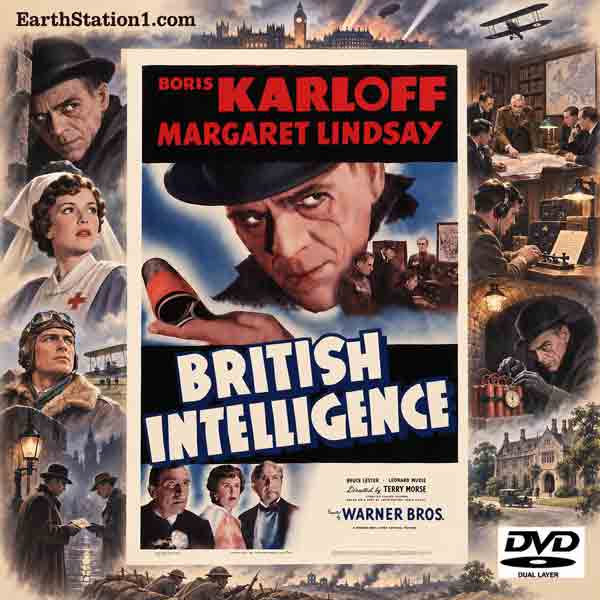
November 23, 1887: #BOTD: #HBD! Boris
Karloff, English actor and horror film star (d. February 2, 1969)
is #born William Henry Pratt in London, England. Pimarily known
for his roles in horror films, he portrayed Frankenstein's monster
in Frankenstein (1931), Bride of Frankenstein (1935), and Son of
Frankenstein (1939), which resulted in his immense popularity. He
also appeared as Imhotep in The Mummy (1932). His best-known
non-horror role is as the Grinch, as well as the narrator, in the
animated television special of Dr. Seuss' How the Grinch Stole
Christmas! (1966). For his contribution to film and television,
Boris Karloff was awarded two stars on the Hollywood Walk of Fame.
A longtime heavy smoker, he had emphysema which left him with only
half of one lung still functioning when he contracted bronchitis
in late 1968 and was hospitalised at University College Hospital
in London, England. He died of pneumonia at King Edward VII
Hospital, Midhurst, in Sussex, at the age of 81. His body was
cremated following a requested modest service at Guildford
Crematorium, Godalming, Surrey, where his ashes are interred. He
is commemorated there by a plaque in The Garden Of Remembrance. A
memorial service was held at St Paul's, Covent Garden ("The
Actors' Church"), London, England, where there is also a
plaque. On Sale Until Midnight Tonight PT!
https://store.earthstation1.com/british-intelligence-1940-boris-karloff-wwi-spy-film-dvd-mp19404.html
Today's
EarthStation1.com 15% (Or More!) Off Commemorative Memorial Title:
The Ten Year Lunch: Wit And Legend Of The Algonquin MP4 Download
DVD
Today, November 23, 2026
November 23, 1888: #BOTD: #HBD! Harpo
Marx, American comedian, actor, mime artist, musician, singer and
secret diplomatic courier for the United States (d. September 28,
1964) is #born Adolph Marx in Manhattan, New York. Harpo was the
second-oldest of the Marx Brothers. In contrast to the mainly
verbal comedy of his brothers Groucho Marx and Chico Marx, Harpo'
comic style was visual, being an example of both clown and
pantomime traditions. He wore a curly reddish blonde wig, and
never spoke during performances (he blew a horn or whistled to
communicate). He frequently used props such as a horn cane, made
up of a lead pipe, tape, and a bulbhorn, and he played the harp in
most of his films. In 1933, following U.S. diplomatic recognition
of the Soviet Union, Harpo spent six weeks in Moscow as a
performer and goodwill ambassador. His tour was a huge success,
and the show ran for six weeks. Harpo's name was transliterated
into Russian, using the Cyrillic alphabet, as "XAPNO MAPKC,"
which is how he was billed during his Soviet Union appearances.
Harpo, having no knowledge of Russian, pronounced it as "Exapno
Mapcase". At that time, Harpo and the Soviet Foreign Minister
Maxim Litvinov became friends and even performed a routine on
stage together. During this time he served as a secret courier,
delivering communiques to and from the US embassy in Moscow at the
request of Ambassador William Christian Bullitt Jr., smuggling the
messages in and out of the Soviet Union by taping a sealed
envelope to his leg beneath his trousers. Marx recounted his
relief at his voyage's end: "I pulled up my pants, ripped off
the tape, unwound the straps, handed over the dispatches from
Ambassador Bullitt, and gave my leg its first scratch in ten
days." Harpo Marx died on his 28th wedding anniversary at age
75 in a West Los Angeles hospital, one day after undergoing heart
surgery. Harpo's death was said to have hit the surviving Marx
brothers very hard. Groucho's son Arthur Marx, who attended the
funeral with most of the Marx family, later said that Harpo's
funeral was the only time in his life that he ever saw his father
cry. In his will, Harpo Marx donated his trademark harp to the
State of Israel, where it was later used in an Israeli orchestra.
His remains were cremated at the Hollywood Forever Cemetery and a
portion of his ashes were allegedly scattered in the sand trap at
the 7th hole of a golf course in Rancho Mirage, California. He was
survived by his wife Susan, four children Bill, Alex, Jimmy, and
Minnie and younger brothers Groucho, Gummo and Zeppo. On Sale
Until Midnight Tonight PT!
https://store.earthstation1.com/the-ten-year-lunch-wit-and-legend-of-algonquin-round-table-dvd.html
Today's
EarthStation1.com 15% (Or More!) Off Commemorative Memorial Title:
Franklin D. Roosevelt Documentaries DVD, Video Download, USB Drive
Today, November 23, 2026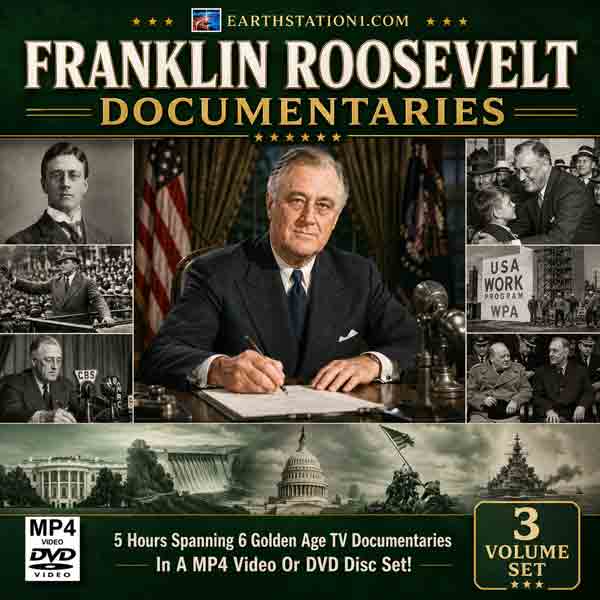
November 23, 1939: The United States: The
History Of The United States: Federal Holidays In The United
States: Thanksgiving (Thanksgiving Day, Thanksgiving [US],
American Thanksgiving): Franksgiving: -- Thanksgiving is
celebrated for the first time not on the last Thursday of November
but rather on that year's fourth Thursday, in accordance with
President Franklin Roosevelt's Executive Order to that effect.
This change was intended to help boost the economy by providing an
extra seven days for Christmas shopping. Despite this decision
leading to significant public backlash, with many people deriding
the holiday as Franksgiving, in December 1941, just after
America's entry into World War II, Congress made it a point to
approve the president's traditional yearly Thanksgiving
Proclamation, especially that proclamation's designating the
federal Thanksgiving Day holiday as the fourth Thursday in
November, starting in 1942. As a result, Thanksgiving would from
then on be celebrated between November 22 and 28, the fourth
Thursdays of any given November. On Sale Until Midnight Tonight
PT!
https://store.earthstation1.com/franklin-roosevelt-documentaries-dual-layer-dvd.html
Today's
EarthStation1.com 15% (Or More!) Off Commemorative Memorial Title:
The Battle Of Tarawa Documentary Set WWII Pacific War MP4 Download
DVD
Today, November 23, 2026
November 23, 1943: World War II: The
Pacific War (The Asia-Pacific War, The Asiatic-Pacific Theater,
The Pacific Theater Of World War II): The Pacific Ocean Theater Of
World War II: The Gilbert And Marshall Islands Campaign: Operation
Galvanic: The Battle Of Tarawa: -- The Tarawa and Makin atolls
fall to American forces. On November 20, The Battle Of Tarawa
began in the Pacific War, as American troops attacked the Japanese
on the heavily fortified Gilbert Islands. It took eight days for
the 5th Amphibious Corps, 2nd Marine Division and the 27th
Infantry Division to take Tarawa and Makin Islands. Over 1,000
Americans were killed with 2,311 wounded. The Japanese lost 4,700.
The Battle Of Tarawa (Operation Galvanic) (November 20-23, 1943)
began in the Pacific War as American troops attacked the Japanese
on the heavily fortified Gilbert Islands. The Battle Of Tarawa was
fought on November 20-23, 1943. It took place at the Tarawa Atoll
in the Gilbert Islands, and was part of Operation Galvanic, the
U.S. invasion of the Gilberts. Nearly 6,400 Japanese, Koreans, and
Americans died in the fighting, mostly on and around the small
island of Betio, in the extreme southwest of Tarawa Atoll. The
Battle Of Tarawa was the first American offensive in the critical
central Pacific region. It was also the first time in the Pacific
War that the United States had faced serious Japanese opposition
to an amphibious landing. Previous landings met little or no
initial resistance, but on Tarawa the 4,500 Japanese defenders
were well-supplied and well-prepared, and they fought almost to
the last man, exacting a heavy toll on the United States Marine
Corps. The losses on Tarawa were incurred within 76 hours. On Sale
Until Midnight Tonight PT!
https://store.earthstation1.com/return-to-tarawa-dvd-bill-burrud-world-war-ii-pacific-war.html
Today's
EarthStation1.com 15% (Or More!) Off Commemorative Memorial Title:
One Of The Reasons Why: The War In Vietnam 1945-46 DVD MP4 USB
Drive
Today, November 23, 2026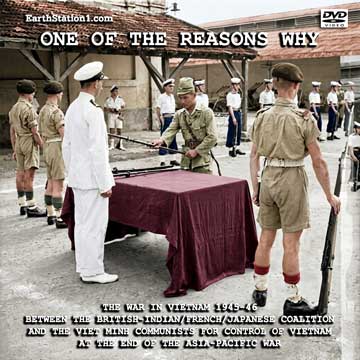
November 23, 1946: The Indochina Wars:
The 1945-46 War In Vietnam (The War in Vietnam 1945-1946, The
First Indochina War, Operation Masterdom, Southern Resistance
War): Events Leading To The 1945-46 War In Vietnam: The Haiphong
Incident (The Haiphong Massacre, The Shelling Of Haiphong): -- The
shocking and tragic chain of events that led to The First
Indochina War -- and ultimately to the The Vietnam War with
America -- begins as the French cruiser Suffren and several avisos
(medium-sized warships designed for colonial service) bombard the
Vietnamese coastal city of Haiphong in North Vietnam, killing
between 2,000 and 6,000 Vietnamese. This incident was the first
armed clash in a series of events that would lead to The Battle Of
Hanoi on December 19, 1946, which marked the official outbreak of
the First Indochina War. After World War II, the future of the
Vietnamese territory was in question. After being under years of
French colonial rule followed by Japanese rule during the war,
Vietnam began to seek independence. Specifically, the Japanese
renounced French claims to the Vietnamese territory on March 9,
1945, officially declaring Vietnam independent over France and
under the control of Emperor B?o D?i. This was counteracted by a
rebellion on September 2, 1945, when Ho Chi Minh and his guerilla
army declared the official birth of the Democratic Republic of
Vietnam. Ho Chi Minh became the leader of the Vietnamese Communist
Party, and demanded complete autonomy from Europe. The French
disregarded these claims of autonomy and quickly moved to resettle
Vietnam as a member for the French Union. However, complete
colonization was no longer an option due to power dynamics in the
west and on March 6, 1946, after receiving pressure from the
western allies, Jean Sainteny, French Commissioner for Northern
Indochina met with Ho Chi Minh in Hanoi and signed the Ho-Sainteny
agreement. The agreement officially gave Vietnam independence as
"a free state with its own government, parliament, army and
finances, forming part of the Indochinese Federation and the
French Union". Additionally, the treaty allowed for the
French to have a military presence in Vietnam for the following
five years. At the time of the signing, it was widely thought that
Ho Chi Minh had given many concessions to the French. By allowing
the continued presence of the French army, Ho Chi Minh allowed for
a continuation of the French colonial control of the past. The
Communist newspaper Les Temps modernes criticized the signing of
the deal, calling the agreement "the lamentable surrender of
all our [Communists] ideological and political plans". On the
French side, Thierry d'Argenlieu illustrated French optimism
regarding the treaty in a communique he wrote to the Parisian
government: "On the French level, the armed forces are
assured of a friendly reception and we are pre-empting any
reproach for opening hostilities ... We are fully safeguarding
French economic and cultural interests now and for the future."
Vietnamese worries in regards to the agreement soon came to
fruition as France began to exert the same colonial authority it
had formally denounced in the treaty. France created a virtual
naval blockade of Haiphong by continuing to have a strong naval
presence in the Gulf of Tonkin. That led the Vietnamese to reach
out for peace talks to curb French influence in the region. These
peace talks came in the form of the Fontainebleau Agreements,
which occurred at the Palace of Fontainebleau and were led by Ph?m
Van D?ng for the Vietnamese and Max Andre on the side of the
French, beginning on July 6, 1946. The conference at the palace
was held to discuss the provisions of the Ho-Sainteny Agreement.
At the conference, the French refused to revise the original
treaty in any way. The Vietnamese leadership, led by Ho Chi Minh,
settled to sign a modus vivendi, postponing talks to a later date.
These talks never occurred due to the outbreak of violence in
November. On the morning of November 20, 1946, a French patrol
ship seized a Chinese junk attempting to bring contraband into
Haiphong. While seemingly routine, the seizure of the ship was the
beginning of a chain of unfortunate events. Vietnamese soldiers
reacted to the seizure by firing on the French ship from the
shore, killing 23 soldiers. Armed clashes immediately broke out on
land between French and Vietnamese nationalists, with a French
burial party being ambushed, losing six more men. The French
immediately worked to dissipate the conflict and stopped the
outbreak by agreeing to respect Vietnamese sovereignty in Haiphong
on November 22, 1946. This, however, was only the beginning of the
incident. Once the news of the skirmish came to Admiral
d'Argenlieu in Paris, he sent a cable to Jean Etienne Valluy,
commander of French forces in Indochina, ordering him to use force
against the Vietnamese in Haiphong. Valluy, in turn, sent an order
to Colonel Debes, commander of the French troops at Haiphong,
stating, "It appears clear that we are up against
premeditated aggressions carefully staged by the Vietnamese
regular army ... The moment has come to give a severe lesson to
those who have treacherously attacked you. Use all the means at
your disposal to make yourself complete master of Haiphong."
Debes then issued an ultimatum to the Vietnamese in Haiphong
demanding a withdrawal from the French section and Chinese
sections of the city, including the port. In the order, Debes
invoked the Franco-Chinese agreement of February 28, 1946, as
justification for demanding the Vietnamese evacuation of parts of
the city. Debes argued that the treaty gave France protective
rights over the Chinese in Vietnam and thus gave them jurisdiction
to engage in combat. After the Vietnamese failed to evacuate in
time, the French began a bombardment of the Vietnamese sections of
the city, using three French avisos: Chevreuil (Chamois-class
minesweeping sloop), Savorgnan de Brazza and Dumont d'Urville. The
role of the cruiser Suffren in the bombardment is controversial,
as some versions of events suggest the ship participated in the
shelling and others claim it arrived after the action had already
been carried out. By November 28, 1946, Colonel Debes had taken
complete control over the town. While reports about the total
number of casualties from the bombardment range widely from
upwards of twenty thousand to less than one hundred. Today the
most commonly cited estimate is around 6,000 deaths as reported by
the French sociologist Paul Mus. The historian Georgette Elgey
considers this estimate to be perhaps excessive as it represents
10% of the city's population, but nevertheless describes the
incident as by far the deadliest of the war. The Viet Minh spread
an estimate of 10,000 to 20,000 killed. French intelligence
services also secretly spread this figure with intention of
showing that the communist Vietnamese state could not protect its
population from the French military. In a letter from December
1946, Ho Chi Minh reported around 3,000 killed during the incident
in the fighting. General Valluy estimated that there were 300
killed. The US consul reported around 2,000 killed. In return,
French forces lost 29 men killed in Hai Phong from November 20 to
23. Immediately after the shelling, the French government sought
peace. All violence was ended by the afternoon of November 22 and
tensions seemed to have been alleviated. This was not the case.
Less than two weeks after the shelling, after receiving pressure
from Paris to "teach the Vietnamese a lesson" General
Morliere ordered a complete Vietnamese withdrawal from the city,
demanding all Viet Minh military elements to be evacuated from
Haiphong. By early December 1946, Haiphong was under complete
French military occupation. The aggressive actions of the French
regarding the occupation of Haiphong made it clear in the eyes of
the Viet Minh that the French intended on maintaining a colonial
presence in Vietnam. The threat of the French establishing a
separate southern state in Vietnam by besieging the city of Hanoi
became a top priority for the Viet Minh to counteract. On December
2, as a final effort to maintain good relations between the two
nations, French Commissioner Sainteny (of the Ho-Sainteny
agreement) visited Hanoi to reach an agreement for a ceasefire.
This proved unsuccessful as the French insistence on maintaining
complete military control of Haiphong stalled all negotiations.
The December 16 election of the socialist Leon Blum as the Premier
of France offered hope to Ho Chi Minh and the Vietnamese, as the
French socialists had a much more tolerant policy towards
Vietnamese independence. That hope proved to be misplaced, as by
the time Blum came into office violence between the Vietnamese and
French was already widespread. As relations between France and
Vietnam continued to worsen, Ho Chi Minh issued a plea for peace
between the two nations on December 12, stating, "Neither
France nor Viet Nam can afford the luxury of a bloody war".
Ho, however, was not completely supported in his call for peace.
Vo Nguyen Giap, leader of the Vietnamese army was convinced that
open confrontation was inevitable. Giap was certain that the
takeover of Haiphong signaled France's intent to attack and take
over Hanoi. This led to Giap focusing on arming the Hanoi militias
in preparation for an attack. The Vietnamese media reflected the
concerns of General Giap. In an article on December 10, 1946, a
Hanoi newspaper stated, "The grave hour has arrived. The
Hanoi Committee of the Viet Minh Front calls on the people to be
calm, to be united, and to be ready to rise when the government
gives the order [to rebel against the French]." The Vietminh
government, in turn, reacted to the plea to prepare, building
barricades in the streets of Hanoi and engaging in armed
skirmishes with French legionnaires. The final ultimatum to the
Vietnamese was issued on December 19, when General Morliere
ordered the leading Viet Minh militia, Tu Ve ("self-defence"),
to completely disarm. That night, all electricity was turned off
in Hanoi and the city was left in complete darkness. The
Vietnamese (specifically the Tu Ve militia) attacked the French
from within Hanoi with machine guns, artillery, and mortars.
Thousands of French soldiers and Vietnamese civilians lost their
lives. The French reacted by storming Hanoi the following day,
forcing the Vietnamese government to take refuge outside of the
city. Ho Chi Minh himself was forced to flee Hanoi for a more
remote mountainous area. The attack can be characterized as a
preemptive strike against the French after the overtaking of
Haiphong endangered Vietnamese claims to Hanoi and all of Vietnam.
The uprising in Hanoi escalated the aggression between the French
and Viet Minh into the First Indochina War. On Sale Until Midnight
Tonight PT!
https://store.earthstation1.com/one-of-the-reasons-whythe-war-in-vietnam-194546-dvd-downlo194546.html
Today's
EarthStation1.com 15% (Or More!) Off Commemorative Memorial Title:
Bank Of Crooks & Criminals The BCCI Scandal DVD MP4 Download
USB Drive
Today, November 23, 2026
November 23, 1950: #BOTD: #HBD! Charles
Schumer, American lawyer and politician, serving from January 20,
2021 to January 3, 2025 as Senate Majority Leader, and in two
stints as Senate Minority Leader from 2017 to 2021 and since 2025,
is #born Charles Ellis Schumer into a Jewish family in Midwood,
Brooklyn, New York City, and is a second cousin, once removed, of
comedian Amy Schumer. A member of the Democratic Party, Schumer is
as of 2022 in his fourth Senate term, having held his seat since
1999, and is the senior United States senator from New York. He is
the dean of New York's congressional delegation. A native of
Brooklyn and a graduate of Harvard College and Harvard Law School,
Schumer was a three-term member of the New York State Assembly
from 1975 to 1980. He served nine terms in the United States House
Of Representatives from 1981 to 1999, first representing New
York's 16th congressional district before being redistricted to
the 10th congressional district in 1983 and 9th congressional
district ten years later. In 1998, Schumer was elected to the
Senate, defeating three-term Republican incumbent Al D'Amato. He
was reelected in 2004 with 71% of the vote, in 2010 with 66% of
the vote, in 2016 with 70% of the vote, and in 2022 with 56% of
the vote as of November 16. Schumer chaired the Democratic
Senatorial Campaign Committee from 2005 to 2009, overseeing 14
Democratic gains in the Senate in the 2006 and 2008 elections. He
was the third-ranking Democrat in the Senate, behind Senate
Majority Leader Harry Reid and Majority Whip Dick Durbin. He
served as Vice Chair of the Democratic Caucus in the Senate from
2007 to 2017 and chaired the Senate Democratic Policy Committee
from 2011 to 2017. Schumer won his fourth term in the Senate in
2016 and was then unanimously elected Democratic leader to succeed
Harry Reid, who was retiring. In January 2021, Schumer became
Senate Majority Leader, and the second Jewish leader of either
chamber of Congress. On Sale Until Midnight Tonight PT!
https://store.earthstation1.com/bank-of-crooks-amp-criminals-the-bcci-scandal-dvd-mp4-download-usb-driv4.html
Today's
EarthStation1.com 15% (Or More!) Off Commemorative Memorial Title:
De Gaulle And France TV Series DVD, Video Download, USB Flash
Drive
Today, November 23, 2026
November 23, 1959: France: The History Of
France: The Modern History Of France: The Presidency Of Charles De
Gaulle: Pan-Europeanism: European Integration: de Gaulle's Europe,
From The Atlantic To The Urals Speech: --- French President
Charles de Gaulle delivers in Strasbourg his "Europe, from
the Atlantic to the Urals" speech calling for European
integration, the process of industrial, political, legal,
economic, social and cultural integration of states wholly or
partially in Europe. In his speech, he declared "Yes, it is
Europe, from the Atlantic to the Urals, it is the whole of Europe,
that will decide the destiny of the world." European
integration has primarily come about through the European Union
and its policies. de Gaulle had set himself the taks of building
Franco-German cooperation as the cornerstone of the European
Economic Community (EEC), paying the first state visit to Germany
by a French head of state since Napoleon. In January 1963, Germany
and France signed the Elysee Treaty, a treaty of friendship.
France also reduced its dollar reserves, trading them for gold
from the Federal government of the United States, thereby reducing
American economic influence abroad. His expression, "Europe,
from the Atlantic to the Urals", has often been cited
throughout the history of European integration. It became, for the
next ten years, a favourite political rallying cry of de Gaulle's.
His vision stood in contrast to the Atlanticism of the United
States and Britain, preferring instead a Europe that would act as
a third pole between the United States and the Soviet Union. By
including in his ideal of Europe all the territory up to the
Urals, de Gaulle was implicitly offering detente to the Soviets.
As the last chief of government of the Fourth Republic, de Gaulle
made sure that the Treaty of Rome creating the European Economic
Community was fully implemented, and that the British project of
Free Trade Area was rejected, to the extent that he was sometimes
considered as a "Father of Europe". On Sale Until
Midnight Tonight PT!
https://store.earthstation1.com/de-gaulle-and-france-3-part-tv-documentary-series-2-disc-dvd-s32.html
Today's
EarthStation1.com 15% (Or More!) Off Commemorative Memorial Title:
Heart Of The Dragon TV Series DVD, Video Download, USB Flash Drive
Today, November 23, 2026
November 23, 1971: China: The History Of
China: China And The United Nations: The People's Republic Of
China's Replacement Of The Republic Of China At The United
Nations: The United Nations General Assembly Resolution 2758 (The
Resolution On Admitting Peking): -- In accordance with the October
25, 1971 General Assembly Resolution 2758 which recognized the
People's Republic Of China as the sole legal China, the President
of The Security Council and the other representatives make
statements welcoming the representatives of the People's Republic
of China for the first time; at that moment, The Republic Of China
(Taiwan) lost not only its Security Council seat, but any
representation in the UN. As one of the victorious Allies of World
War II (the Chinese theatre of which was the Second Sino-Japanese
War), The Republic Of China (ROC) joined the UN as one of its
founding member countries in 1945. The subsequent resumption of
the Chinese Civil War between the government of Republic Of China
and the rebel forces of the Chinese Communist Party, led to the
latter's victory on the mainland and the establishment of the
People's Republic Of China (PRC) in 1949. Nearly all of Mainland
China was soon under its control and the ROC government (then
referred to in the West as "Nationalist China")
retreated to the island of Taiwan. The One-China policy advocated
by both governments dismantled the solution of dual representation
but, amid the Cold War and Korean War, the United States and its
allies opposed the replacement of the ROC at the United Nations
until 1971, although they were persuaded to pressure the
government of the ROC to accept international recognition of
Mongolia's independence in 1961. The PRC sought to be recognized
by the United Nations from the 1950s, but at least until 1961, the
United States managed to keep the PRC out of the UN. The General
Assembly Resolution 1668 which demanded a majority of two thirds
for the recognition of new members was adopted in 1961. Canada and
other allies of the United States individually shifted their
recognitions of China to the PRC, which the US opposed. Some
attempted to recognize both Chinas separately which both Chinas
opposed declaring each one was the only legitimate representative
of China. Annual motions to replace the ROC with the PRC were
introduced first by the Soviet Union, then India and also Albania,
but these were defeated. Amid the Sino-Soviet split and Vietnam
War, United States President Richard Nixon entered into
negotiations with Chinese Communist Party Chairman Mao Zedong,
initially through a secret 1971 trip undertaken by Henry Kissinger
to visit Zhou Enlai. On October 25, 1971, a motion to recognize
the People's Republic Of China as the sole legal China, initiated
by 17 UN members led by Albania, was passed as General Assembly
Resolution 2758. It was supported by most of the communist states
(including the Soviet Union) and non-aligned countries (such as
India), but also by some NATO countries, such as the United
Kingdom and France. After the PRC was seated on 15 November 1971,
Nixon then personally visited mainland China the next year,
beginning the normalization of PRC-USA relations. The Republic Of
China maintained the view it was the sole legitimate
representative of China until 1988, but eventually turned to a
foreign policy which sought international recognition through a
so-called checkbook diplomacy. These moves have been opposed and
mostly blocked by the People's Republic Of China, forcing the
Republic Of China to join international organizations under other
names, including "Chinese Taipei" at the International
Olympic Committee. The Republic Of China's most recent request for
admission was turned down in 2007, but a number of European
governments-led by the United States-protested to the UN's Office
of Legal Affairs to force the global body and its
secretary-general to stop using the reference "Taiwan is a
part of China". On Sale Until Midnight Tonight PT!
https://store.earthstation1.com/heart-of-the-dragon-dvds-post-mao-china-all-12-tv-shows-3-di123.html
Today's
EarthStation1.com 15% (Or More!) Off Commemorative Memorial Title:
High Crimes And Misdemeanors: The Iran-Contra Scandal DVD, MP4,
USB
Today, November 23, 2026
November 23, 1981: Scandals: Political
Scandals: Political Scandals Of The United States: The Aftermath
Of World War II: The Cold War: The Cold War (1979-1985): The
Iran-Iraq War: Iran-United States Relations: The Iran-Contra
Affair (The Iran-Contra Scandal): -- Ronald Reagan signs the top
secret National Security Decision Directive 17 (NSDD-17), giving
the Central Intelligence Agency the authority to recruit and
support Contra rebels in Nicaragua. Under the Boland Amendment, a
term describing three U.S. legislative amendments between 1982 and
1984, further funding of the Contras by the government had been
prohibited by Congress, so execution of this directive was
performed covertly. Entititled "NATIONAL SECURITY DECISION
DIRECTIVE ON CUBA AND CENTRAL AMERICA", NSDD-17 read: "U.S.
policy toward the Americas is characterized by strong support for
those nations which embrace t~e principles of democracy and
freedom for their people in a stable and peaceful environment.
u.s. policy is therefore to assist in defeating the insurgency in
El Salvador, and to oppose actions by Cuba, Nicaragua, or others
to introduce into Central America heavy weapons, troops from
outside the region, trained subversives, or arms and military
supplies for insurgents. To adequately support u.s. policy, the
following decisions have been made by the President based on
discussion at the November 16, 1981 meeting of the National
Security Council: 1. Create a public information task force to
inform the publ_ic and Congress of the critical situation in the
area. 2. Economic support for a number of Central American and
Caribbean countries (estimate 250M USD to 300M USD FY 1982
supplemental) 3. Agreement to use most of the 50M USD Section .506
authority to increase military assistance to El Salvador and
Honduras. Reprogram additional funds as necessary. 4. Provide
military training for indigenous units and leaders both in and out
of country 5. Enhance U.S. and host country intelligence
capa-bilities and sharing in the Caribbean Basin area. 6. Maintain
trade and credit to Nicaragua as long as the government permits
the private sector to operate effectively. 7. Expedite measures to
tighten the economic sanctions against Cuba. 8. Encourage
cooperative efforts to defeat externally-supported insurgency by
pursuing a multilateral step-by-step approach. 9. Support
democratic forces in Nicaragua. 10. Prepare appropriate military
contingency plans for action against Cuban forces should they be
introduced into Central America. 11. Improve military preparedness
against Cuba and develop contingency plans for action against
Cuba." On Sale Until Midnight Tonight PT!
https://store.earthstation1.com/high-crimes-and-misdemeanors-the-ironcontra-scandal-dvd.html
Today's
EarthStation1.com 15% (Or More!) Off Commemorative Memorial Title:
America: The Second Century Documentary Series DVD, Download, USB
Today, November 23, 2026
November 23, 1876: Crime: Organized
Crime: Organized Crime In The United States: Political Corruption
In The United States: Democratic Party Corruption: Political
Machines In The United States: Irish-American Crime: Organized
Crime: Secret Societies In The United States: Tammany Hall (The
Society Of St. Tammany, The Sons Of St. Tammany, The Columbian
Order, The Tammany Society): The Extradition Of Boss Tweed: --
William M. "Boss" Tweed, corrupt Tammany Hall leader, is
delivered to authorities in New York City after being captured in
Spain. He was an American politician most notable for being the
"boss" of Tammany Hall, the Democratic Party political
machine that played a major role in the politics of 19th century
New York City and State. At the height of his influence, Tweed was
the third-largest landowner in New York City and a director of the
Erie Railroad, the Tenth National Bank, and the New-York Printing
Company, as well as proprietor of the Metropolitan Hotel. Tweed
was elected to the United States House Of Representatives in 1852
and the New York County board of supervisors in 1858, the year he
became the head of the Tammany Hall political machine. He was also
elected to the New York State Senate in 1867, but Tweed's greatest
influence came from being an appointed member of a number of
boards and commissions, his control over political patronage in
New York City through Tammany, and his ability to ensure the
loyalty of voters through jobs he could create and dispense on
city-related projects. Tweed was convicted for stealing an amount
estimated by an aldermen's committee in 1877 at between 25M and
45M USD from New York City taxpayers through political corruption,
although later estimates ranged as high as 200M USD. Unable to
make bail, he escaped from jail once, but was returned to custody.
He died in the Ludlow Street Jail. On Sale Until Midnight Tonight
PT!
https://store.earthstation1.com/america-the-second-century-us-2nd-100-years-history-621006.html
Today's
EarthStation1.com 15% (Or More!) Off Commemorative Memorial Title:
The Mexican Revolution 1910-1920 DVD, Video Download, USB Drive
Today, November 23, 2026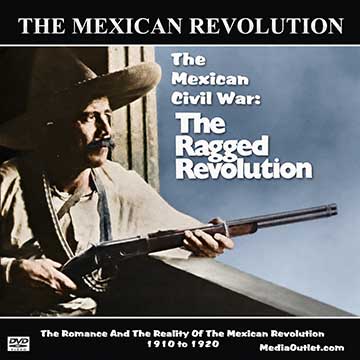
November 23, 1914: 20th Century
Revolutions: The Mexican Revolution: The Battle Of Veracruz: The
United States Occupation Of Veracruz: -- The last U.S. forces
withdraw from Veracruz, occupied seven months earlier in response
to the Tampico Affair. The Tampico Affair began as a minor
incident involving U.S. sailors and Mexican land forces loyal to
Mexican dictator General Victoriano Huerta during the guerra de
las facciones (faction wars) phase of the Mexican Revolution. A
misunderstanding occurred on April 9, 1914, but developed into a
breakdown of diplomatic relations between the two countries. As a
result, the United States invaded the port city of Veracruz,
occupying it for more than six months. This contributed to the
fall of President Victoriano Huerta, who resigned in July 1914. In
the midst of the Mexican Revolution, de facto President Huerta
struggled to defend his power and territory from the forces of
Emiliano Zapata in the state of Morelos and the rapid advance of
the Northern opposition Constitutionalists under the leadership of
Venustiano Carranza. By March 26, 1914, Carranza's forces were 10
mi (16 km) from the prosperous coastal oil town of Tampico,
Tamaulipas. There was a considerable settlement of U.S. citizens
in the area due to the immense investment by U.S. firms in the
local oil industry. Several U.S. Navy warships commanded by Rear
Admiral Henry T. Mayo were deployed off the coast for the stated
purpose of protecting American citizens and property. The U.S.
occupation of Veracruz resulted in widespread anti-American
sentiment among Mexican residents, and other U.S. warships were
used to evacuate U.S. nationals from both the Gulf Coast and the
west coast of Mexico, taking them to refugee centers in San Diego,
California; Texas; and New Orleans. As a result of anti-American
sentiment, Mexico maintained neutrality during World War I,
refusing to support the U.S. in Europe, all the while continuing
to do business with Germany. With the U.S. threatening to invade
in 1918 to take control of Tampico oil fields, Mexican President
Venustiano Carranza threatened to have them destroyed to prevent
their falling under U.S. control. On Sale Until Midnight Tonight
PT!
https://store.earthstation1.com/the-ragged-revolution-mexican-revolt-191019101920.html
Today's
EarthStation1.com 15% (Or More!) Off Commemorative Memorial Title:
Shevardnadze Uncovered Eduard Shevardnadze's Georgia DVD MP4 USB
Drive
Today, November 23, 2026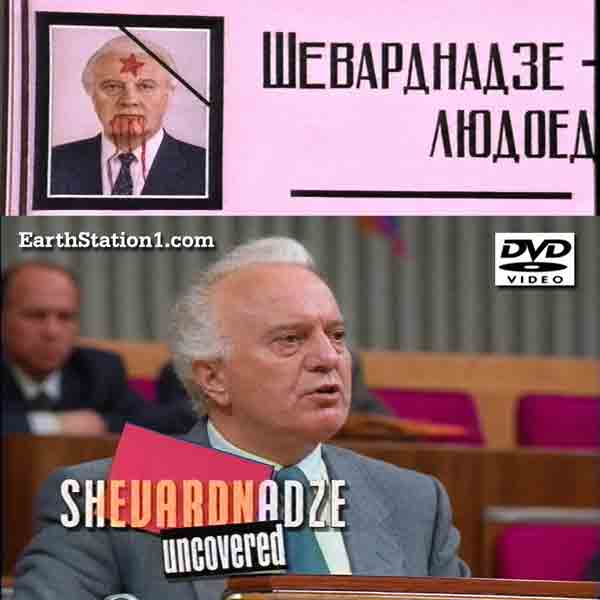
November 23, 2003: 21st Century
Revolutions: Post-Soviet States (The Former Soviet Union, Former
Soviet Republics): Post Cold War Conflicts In Europe: Colour
Revolutions (Color Revolutions: Coloured Revolutions, Colored
Revolutions): Non-Violent Revolutions: The Rose Revolution (The
Revolution Of Roses): -- Georgian president Eduard Shevardnadze
resigns following weeks of mass protests over flawed elections.
The Revolution of Roses, often translated into English as the Rose
Revolution (Georgian: Vardebis Revolutsia), was a pro-Western
peaceful change of power in Georgia in November 2003. The
revolution was brought about by widespread protests over the
disputed parliamentary elections and culminated in the ousting of
President Eduard Shevardnadze, which marked the end of the Soviet
era of leadership in the country. The event derives its name from
the climactic moment, when demonstrators led by Mikheil
Saakashvili stormed the Parliament session with red roses in hand.
Consisting of twenty days of protests from November 3 to 23, 2003,
the Revolution triggered new presidential and parliamentary
elections in Georgia, which established the United National
Movement as the dominant ruling party. Following the Rose
Revolution, Georgia pursued a decidedly pro-Western foreign policy
and declared European and Euro-Atlantic integration as its main
priority; this change in trajectory contributed to Georgia's
tensions with Russia, which continue to this day. On Sale Until
Midnight Tonight PT!
https://store.earthstation1.com/shevardnadze-uncovered-eduard-shevardnadze39s-georgia-dvd-mp4-394.html
Today's
EarthStation1.com 15% (Or More!) Off Commemorative Memorial Title:
Murder In Mississippi: Freedom Summer Murders Informants DVD MP4
USB
Today, November 23, 2026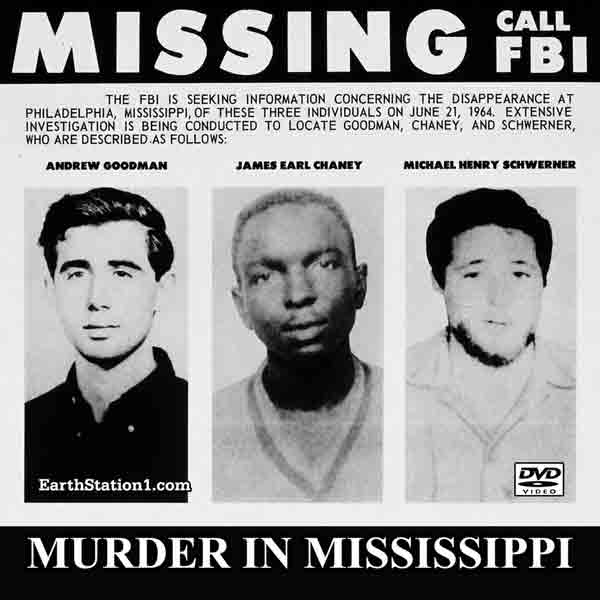
November 23, 1943: #BOTD: #HBD! Andrew
Goodman, American social worker and civil rights activist (d. June
21, 1964) is #born Andrew Goodman in the Upper West Side of New
York City, at 161 West 86 Street, the second of three boys born of
Robert and Carolyn Goodman, who like his fellow murdered activist
Michael Schwerner, was Jewish. He was one of three Civil Rights
Movement activists murdered during Freedom Summer in 1964 by
members of the Ku Klux Klan on June 21, 1964, a crime collectively
known as The Murders Of Chaney, Goodman, and Schwerner: The
murders of Chaney, Goodman, and Schwerner, also known as the
Freedom Summer Murders, the Mississippi civil rights workers'
murders or the Mississippi Burning murders, occured when civil
rights workers, two white and one black, were abducted and
murdered in Neshoba County, James Chaney, Andrew Goodman and
Michael Schwerner, after they left Meridian, Mississippi, at 9
a.m. to investigate a church burning. They were expected back by 4
p.m. When they failed to return, a search was begun. Their
murdered bodies were discovered on August 4. The victims were
James Chaney from Meridian, Mississippi, and Andrew Goodman and
Michael Schwerner from New York City. All three were associated
with the Council of Federated Organizations (COFO) and its member
organization, the Congress Of Racial Equality (CORE). They had
been working with the Freedom Summer campaign by attempting to
register African Americans in Mississippi to vote. This
registration effort was a part of contesting over 70 years of laws
and practices that supported a systematic policy, begun by several
states in 1890, of disenfranchisement of potential black voters.
The three men had traveled from Meridian to the community of
Longdale to talk with congregation members at a black church that
had been burned. The trio was thereafter arrested by Neshoba
County Deputy Sheriff Cecil Price following a traffic stop outside
Philadelphia, Mississippi for speeding, escorted to the local
jail, and held for a number of hours. As the three left town in
their car, they were followed by law enforcement and others.
Before leaving Neshoba County, the car was pulled over and all
three were abducted, driven to another location, and shot at close
range. The three men's bodies were then transported to an earthen
dam where they were buried. The disappearance of the three men was
initially investigated as a missing persons case. The civil rights
workers' burnt-out car was found near a swamp three days after
their disappearance. An extensive search of the area was conducted
by the Federal Bureau of Investigation (FBI), local and state
authorities, and four hundred United States Navy sailors. The
three men's bodies were only discovered two months later thanks to
a tip-off. During the investigation it emerged that members of the
local White Knights of the Ku Klux Klan, the Neshoba County
Sheriff's Office and the Philadelphia Police Department were
involved in the incident. Andrew Goodman's body was reinterred at
Mount Judah Cemetery in Ridgewood, Queens County, New York. The
murder of the activists sparked national outrage and an extensive
federal investigation, filed as Mississippi Burning (MIBURN),
which later became the title of a 1988 film loosely based on the
events. In 1967, after the state government refused to prosecute,
the United States federal government charged eighteen individuals
with civil rights violations. Seven were convicted and received
relatively minor sentences for their actions. Outrage over the
activists' disappearances helped gain passage of the Civil Rights
Act Of 1964. On the 41st anniversary of the murders, on June 21,
2005, Edgar Ray Killen, who had previously been acquitted for the
murders of James Chaney, Andrew Goodman, and Mickey Schwerner, was
convicted of manslaughter as a result of the case having been
reopened in 2004 by the state of Mississippi for his part in the
crimes. He was given a 60-year sentence. On June 20, 2016, federal
and state authorities officially closed the case and dispensed
with the possibility of further prosecution. Killen died in prison
in January 2018. On Sale Until Midnight Tonight PT!
https://store.earthstation1.com/murder-in-mississippi-freedom-summer-murders-informants-dvd-mp4-us4.html
Today's
EarthStation1.com #OnThisDay Commemorative Memorial Title: A
Dangerous Man: Lawrence After Arabia WWI Aftermath DVD, MP4, USB
Today, November 23, 2026 November 23, 1917: The European Civil
War: World War I: The First European War (The European Theater Of
World War I): The African Theatre Of World War I: The Middle
Eastern Theater Of World War I: The Sykes-Picot Agreement: -- The
Russian Bolshevik government makes public the Sykes-Picot
Agreement between the United Kingdom and France signed in 1916
that defined mutually agreed-to spheres of influence and control
in an eventual partition of the Ottoman Empire, including such
territories as Iraq and Syria. Three days later, on November 26,
1917, The Manchester Guardian newspaper published the text of the
agreement. During the closing years of the war, T.E. Lawrence,
later popularly known as Lawrence of Arabia, sought to convince
his superiors in the British government that Arab independence was
in their interests, but the secret Sykes-Picot Agreement
contradicted the promises of independence that he had made to the
Arabs, and thereby frustrated his work. The Sykes-Picot Agreement
also had the assent from the Russian Empire and the Kingdom of
Italy. The agreement was based on the premise that the Triple
Entente would achieve success in defeating the Ottoman Empire
during World War I and formed part of a series of secret
agreements contemplating its partition. The primary negotiations
leading to the agreement took place between November 23, 1915 and
January 3, 1916, on which date the British and French diplomats,
Mark Sykes and Francois Georges-Picot, initialled an agreed
memorandum. The agreement was ratified by their respective
governments on May 9 and 16, 1916. The agreement effectively
divided the Ottoman provinces outside the Arabian Peninsula into
areas of British and French control and influence. The British-
and French-controlled countries were divided by the Sykes-Picot
line. The agreement allocated to the UK control of what is today
southern Israel and Palestine, Jordan and southern Iraq, and an
additional small area that included the ports of Haifa and Acre to
allow access to the Mediterranean. France was to control
southeastern Turkey, the Kurdistan Region, Syria and Lebanon. As a
result of the included Sazonov-Paleologue Agreement, Russia was to
get Western Armenia in addition to Constantinople and the Turkish
Straits already promised under the 1915 Constantinople Agreement.
Italy assented to the agreement in 1917 via the Agreement of
Saint-Jean-de-Maurienne and received southern Anatolia. The
Palestine region, with a smaller area than the later Mandatory
Palestine, was to fall under an "international
administration". The agreement was initially used directly as
the basis for the 1918 Anglo-French Modus Vivendi, which provided
a framework for the Occupied Enemy Territory Administration in the
Levant. More broadly it was to lead, indirectly, to the subsequent
partitioning of the Ottoman Empire following Ottoman defeat in
1918. Shortly after the war, the French ceded Palestine and Mosul
to the British. Mandates in the Levant and Mesopotamia were
assigned at the April 1920 San Remo conference following the
Sykes-Picot framework; the British Mandate for Palestine ran until
1948, the British Mandate for Mesopotamia was to be replaced by a
similar treaty with Mandatory Iraq, and the French Mandate for
Syria and the Lebanon lasted until 1946. The Anatolian parts of
the agreement were assigned by the August 1920 Treaty of Sevres;
however, these ambitions were thwarted by the 1919-23 Turkish War
Of Independence and the subsequent Treaty of Lausanne. The
agreement is seen by many as a turning point in Western and Arab
relations. It reneged upon the UK's promises to Arabs regarding a
national Arab homeland in the area of Greater Syria in exchange
for supporting the British against the Ottoman Empire. The
agreement, along with others, was made public by the Bolsheviks in
Moscow on November 23, 1917, and was thereafter repeated in The
Manchester Guardian three days later, such that "the British
were embarrassed, the Arabs dismayed and the Turks delighted".
The agreement's legacy has led to much resentment in the region,
among Arabs in particular but also among Kurds who were denied an
independent state.
https://store.earthstation1.com/a-dangerous-man-lawrence-after-arabia-19921992.html
Today's
EarthStation1.com #OnThisDay Commemorative Memorial Title: The
Salvadoran Civil War (1990 Documentary) MP4 Video Download DVD
Today, November 23, 2026November 23, 1925: #BOTD: Jose Napoleon
Duarte, Salvadoran engineer and politician, mayor of San Salvador
before running a losing race for the presidency in 1972 in an
election widely viewed as fraudulent, leader of El Salvador's
civil-military Junta from 1980 to 1982 following its 1979 coup
d'etat, elected president in 1984 after defeating the center-right
ARENA party leader Roberto D'Aubuisson, President of El Salvador
from June 1, 1984 to June 1, 1989 (d. February 23, 1990) is #born
Jose Napoleon Duarte Fuentes in the city of Santa Ana, Santa Ana
department, El Salvador. Supported by the American Reagan
Administration and the Central Intelligence Agency, his time in
office occurred during the worst years of The Salvadoran Civil
War, which saw numerous abuses and massacres of the civilian
population by the Salvadoran security forces and the death squads
linked to them. He died of stomach cancer in El Salvador's capital
city of San Salvador, aged 64. He is buried in Jardines Del
Recuerdo Cemetery in San Salvador.
https://store.earthstation1.com/the-salvadoran-civil-war-1990-documentary-mp4-video-download-dvd.html
Today's
EarthStation1.com #OnThisDay Commemorative Memorial Title: The
Secret Game 1917 WWI Spy Film Sessue Hayakawa DVD, MP4, USB Drive
Today, November 23, 2026November 23, 1973: #DOTD: #RIP: Sessue
Hayakawa, Japanese actor and producer (b. June 10,1889) #dies from
a cerebral thrombosis, complicated by pneumonia at the age of 87.
He was buried in the Chokeiji Temple Cemetery in Toyama, Japan.
Born Kintaro Hayakawa, known professionally as Sessue Hayakawa, he
one of the biggest stars in Hollywood during the silent film era
of the 1910s and 1920s. Hayakawa was the first actor of Asian
descent to achieve stardom as a leading man in the United States
and Europe. His "broodingly handsome" good looks and
typecasting as a sexually dominant villain made him a heartthrob
among American women during a time of racial discrimination, and
he became one of the first male sex symbols of Hollywood. After
being expelled from the Japanese naval academy and surviving a
suicide attempt at 18, Hayakawa attended the University of
Chicago, where he studied political economics and quarterbacked
the school's football team. Upon graduating, he traveled to Los
Angeles in order to board a scheduled ship back to Japan, but
decided to try out acting in Little Tokyo. There, Hayakawa
impressed Hollywood figures and was signed on to star in The
Typhoon (1914). He made his breakthrough in The Cheat (1915), and
thereafter became famous for his roles as a forbidden lover.
Hayakawa was one of the highest paid stars of his time, earning 5K
USD per week in 1915, and 2M USD per year through his own
production company from 1918 to 1921. Hayakawa's popularity and
sex appeal ("his most rabid fan base was white women")
unsettled many segments of American society which were filled with
feelings of the Yellow Peril. With two World Wars taking place
throughout his career, and rising anti-Asian sentiment in the
United States, the types of roles that he usually played were
gradually "taken over by other actors who were not as
threatening as Hayakawa in terms of race and sex". Hayakawa
left Hollywood in 1922 and worked in Japanese and European cinema
for many years before making his Hollywood comeback in Tokyo Joe
(1949). Of his talkies, Hayakawa is probably best known for his
role as Colonel Saito in The Bridge on the River Kwai (1957), for
which he earned a nomination for the Academy Award for Best
Supporting Actor. Hayakawa starred in over 80 feature films, and
two of his films (The Cheat and The Bridge on the River Kwai)
stand in the United States National Film Registry.
https://store.earthstation1.com/the-secret-game-1917-dvd-sessue-hayakawa1917.html
Today's
EarthStation1.com #OnThisDay Commemorative Memorial Title: Akira
Kurosawa (1979) Film Director Documentary DVD, Download, USB
Today, November 23, 2026November 23, 1932: #BOTD: #HBD! Kunie
Tanaka, Japanese actor who first made a name for himself as the
lecherous antagonist of the Wakadaisho series (1961-1981) of
films, and in Akira Kurosawa's The Bad Sleep Well (1960), Sanjuro
(1962) and Dodes'ka-den (1970) (d. March 24, 2021) is #born Tanaka
Kunie in Toki District, Gifu Prefecture, Honshu, Japan. He is also
well-known for his roles in Kinji Fukasaku's yakuza films, namely
the Battles Without Honor and Humanity series (1973-1974), and for
starring in the Kita no Kuni Kara (1981-2002) television series.
Tanaka was nominated for five Japanese Academy Awards, winning
Best Supporting Actor for Gakko in 1993. He also won the Blue
Ribbon Award for Best Supporting Actor for Nogare no Machi and
Izakaya Choji in 1983, and the Blue Ribbon Award for Best Actor
for Uhohho Tankentai in 1986. For his contributions to the arts,
the Japanese government decorated Tanaka with the Medal with
Purple Ribbon in 1999 and the Order of the Rising Sun in 2006.
Kunie Tanaka died of natural causes in Yokohama, Kanagawa, Japan,
aged 88. Tanaka's funeral was held with his family. His burial
details are not publicly disclosed.
https://store.earthstation1.com/akira-kurosawa-film-director-dvd.html
Today's
EarthStation1.com #OnThisDay Commemorative Memorial Title: Coup De
Torchon aka Clean Slate (1981) DVD, MP4 Download, USB Drive
Today, November 23, 2026November 23, 2006: #DOTD: #RIP: Philippe
Noiret (fill-EEP new-ahr-REY), French film actor with more than
100 film roles to his credit, best known for his roles as Alfredo
in Cinema Paradiso (1988), Pablo Neruda in Il Postino, and Major
Dellaplane in Bertrand Tavernier's Life and Nothing But (b.
October 1, 1930) #dies of cancer in Paris, France, aged 76. He is
buried in Montparnasse Cemetery, Montparnasse, Paris, France.
Noiret was cast primarily as the Everyman character, although he
did not hesitate to accept controversial roles, such as in La
Grande Bouffe, a film about suicide by overeating, which caused a
scandal at Cannes in 1973, and in 1991 Andre Techine cast Noiret
in J'embrasse pas (I Don't Kiss), as a melancholy old homosexual
obsessed with young male flesh. And in 1987, in The Gold Rimmed
Glasses based on Giorgio Bassani's novel about the cramped social
life of post-war Ferrara in Italy, he played an elderly and
respectable doctor who is gradually suspected of being a covert
homosexual with a passion for a beautiful young man (Rupert
Everett). Noiret won his first Cesar Award for his role in Vieux
Fusil in 1976. His second Cesar came in 1990 for his role in Life
and Nothing But. Philippe Noiret was born in Lille, France, the
son of Lucy (Heirman) and Pierre Noiret, a clothing company
representative. He was an indifferent student and attended several
prestigious Paris schools, including the Lycee Janson de Sailly.
He failed several times to pass his baccalaureat exams, so he
decided to study theater. He trained at the Centre Dramatique de
l'Ouest and toured with the Theatre National Populaire for seven
years, where he met Monique Chaumette, whom he married in 1962.
During that time he developed a career as a nightclub comedian in
a duo act with Jean-Pierre Darras, in which he played Louis XIV in
an extravagant wig opposite Darras as the dramatist Jean Racine.
In these roles they satirized the politics of Charles de Gaulle,
Michel Debre and Andre Malraux. Noiret's screen debut (1949) was
an uncredited role in Gigi. In 1955 he appeared in La Pointe
Courte directed by Agnes Varda. She said later, "I discovered
in him a breadth of talent rare in a young actor." Sporting a
pudding-basin haircut, Noiret played a lovelorn youth in the
southern fishing port of Sete. He later admitted: "I was
scared stiff, and fumbled my way through the part-I am totally
absent in the film." He was not cast again until 1960 in
Zazie dans le Metro. After playing second leads in Georges
Franju's Therese Desqueyroux in 1962, and in Le Capitaine
Fracasse, from Theophile Gautier's romantic adventure, he became a
regular on the French screen, without being cast in major roles
until A Matter of Resistance directed by Jean-Paul Rappeneau in
1966. He became a star in France with Yves Robert's Alexandre le
Bienheureux. Noiret appeared in Hollywood-financed films by Alfred
Hitchcock (Topaz), George Cukor (Justine), Ted Kotcheff (Who is
Killing the Great Chefs of Europe?), Peter Yates (Murphy's War)
and Anatole Litvak (The Night of the Generals). "When I began
to have success in the movies," Noiret told film critic Joe
Leydon at the Cannes Film Festival in 1989, "it was a big
surprise for me. For actors of my generation-all the men of 50 or
60 now in French movies-all of us were thinking of being stage
actors. Even people like Jean-Paul Belmondo, all of us, we never
thought we'd become movie stars. So, at the beginning, I was just
doing it for the money, and because they asked me to do it. But
after two or three years of working on movies, I started to enjoy
it, and to be very interested in it. And I'm still very interested
in it, because I've never really understood how it works. I mean,
what is acting for the movies? I've never really understood."
He often joked with interviewers about his virtually non-stop work
schedule, telling Joe Leydon in 1989: "You never know what
will be the success of a film. And it's always comfortable to be
making another film when you're reading terrible notices for your
last film. You can say, 'Well, that's a pity, but I'm already
working on another job.' It helps in your living. You see, if
you're only making one film a year, or one film every year and a
half, it's hard. Because when it's a failure, what do you do? What
do you become? You're dead."
https://store.earthstation1.com/coup-de-torchon-aka-clean-slate-1981-dvd-mp4-usb-19814.html
Today's
EarthStation1.com #OnThisDay Commemorative Memorial Title: TV
Commercials: The Cable Age Classics III DVD, Download, USB Drive
Today, November 23, 2026November 23, 1936: #BOTD: #HBD! Steve
Landesberg, American actor, comedian and screenwriter, best known
for his role as the erudite, unflappable police detective Arthur
P. Dietrich on the ABC sitcom Barney Miller, for which he was
nominated for three Emmy Awards (d. December 20, 2010) is #born in
the Bronx, New York. He was part of improv group New York
Stickball Team, which performed several shows that aired on cable
television shortly after Barney Miller went off the air.
Landesberg was a member of the cast of the 1974 CBS situation
comedy Paul Sand in Friends and Lovers. He made guest appearances
on The Tonight Show, The Rockford Files, Law & Order, Saturday
Night Live, The Golden Girls, Ghost Whisperer, That '70s Show and
Everybody Hates Chris. He starred in Starz's original show Head
Case as Dr. Myron Finkelstein. He appeared in the motion pictures
Wild Hogs, Leader of the Band, and Forgetting Sarah Marshall. He
appeared in 124 episodes of Barney Miller as Det. Sgt. Arthur
Dietrich, starting from the last episode of the 1975 season until
the end of the series in 1982. Landesberg also co-starred in the
TV pilot Black Bart, a spin-off of Blazing Saddles. He attempted a
comeback to television playing a public defender in Seattle in an
unsold sitcom pilot, The Best Defense, later aired on June 19,
1995, on ABC. In the mid-1980s, Landesberg was the spokesman in TV
and print advertisements for Northwestern Bell's long-distance
telephone services. He also was a TV spokesman for AAMCO
Transmissions in the 1980s and early 1990s, and for The Discovery
Channel, Canadian Airlines and Office Depot in the 1990s. He and
his wife, Nancy Ross Landesberg, had a daughter, Elizabeth.
Landesberg died from colon cancer in Los Angeles, California, aged
74. His remains were cremated, and the ashes given to his widow
Nancy Ross.
https://store.earthstation1.com/tv-commercials-the-cable-age-classics-iii-dvd.html
Today's
EarthStation1.com #OnThisDay Commemorative Memorial Title: John
Cleese Interview With Melvyn Bragg 1986 DVD, Download, USB Drive
Today, November 23, 2026November 23, 2016: #DOTD: #RIP: Andrew
Sachs, German-born British actor who made his name on British
television and found his greatest fame in 1975 for his portrayal
of the comical Spanish waiter Manuel in Fawlty Towers (b. April, 7
1930) #dies aged 86 of vascular dementia at the Denville Hall
nursing home in Northwood, London, England, a historic building
which is used as a retirement home for professional actors,
actresses and members of other theatrical professions. His funeral
took place on December 1, the same day his death was publicly
announced. His remains were cremated, and his ashes were given to
his family. On December 2, 2016, BBC One broadcast the Fawlty
Towers episode "Communication Problems" in his memory.
John Cleese paid tribute to Sachs, describing him as a "sweet,
sweet man". Andrew Sachs was born Andreas Siegfried Sachs in
Berlin, Germany, the son of Katharina (nee Schrott-Fiecht), a
Lutheran librarian, and Hans Emil Sachs, a Jewish insurance
broker. The family moved to Britain in 1938 to escape the Nazis.
He had a long career in acting and voice-over work for television,
film and radio. He was successful well into his eighties, with
roles in numerous films such as Quartet, and as Ramsay Clegg in
Coronation Street.
https://store.earthstation1.com/john-cleese-interview-with-melvyn-bragg-dvd-1986.html
Today's
EarthStation1.com #OnThisDay Commemorative Memorial Title: Clive
James' Fame In The 20th Century TV Series DVD Set MP4 USB Drive
Today, November 23, 2026November 23, 2012: #DOTD: #RIP: Larry
Hagman, American actor, director, and producer, best known for
playing ruthless oil baron J. R. Ewing in the 1978-1991 primetime
television soap opera Dallas, and the handsome astronaut Major
Anthony Nelson in the 1965-1970 sitcom I Dream of Jeannie (b.
September 21, 1931) #dies at Medical City Dallas Hospital in
Dallas, Texas from complications of acute myeloid leukemia, aged
81. His remains were cremated, and the ashes scattered over
Southfork Ranch in Parker, Texas; Southfork Ranch includes the
Ewing Mansion, the setting for the television series Dallas. Larry
Hagman was born Larry Martin Hagman Larry Hagman in Fort Worth,
Texas. His mother was Mary Martin, Broadway actress and musical
comedy star who became famous after his birth. His father,
Benjamin Jackson Hagman, who was of Swedish descent, was an
accountant and lawyer who worked as a district attorney. Hagman's
parents divorced in 1936 when he was five years old. Hagman had
supporting roles in numerous films, including Fail-Safe, Harry And
Tonto, S.O.B., Nixon, and Primary Colors. His television
appearances also included guest roles on dozens of shows spanning
from the late 1950s until his death, and a reprise of his
signature role on the 2012 revival of Dallas. Hagman also worked
as a television producer and director. Hagman underwent a
life-saving liver transplant in 1995.
https://store.earthstation1.com/clive-james39-fame-in-the-20th-century-tv-series-dvd-set-mp4-usb-39204.html
Today's
EarthStation1.com #OnThisDay Commemorative Memorial Title: The
Civil War: A Video Image History JPG Set + MPG DVD, Download, USB
Today, November 23, 2026November 23, 1863: The American Civil War
(The Civil War, The War Between The States): The Eastern Theater
Of The American Civil War: The Chattanooga Campaign: The Battles
Of Chattanooga: The Battle Of Chattanooga (The Third Battle Of
Chattanooga): -- The Battle Of Chattanooga begins as Union forces
led by General Ulysses S. Grant reinforce troops at Chattanooga,
Tennessee, and counter-attack Confederate troops. The following
day, The Battle Of Lookout Mountain would be fought as Union
forces under Maj. Gen. Joseph Hooker would assault Lookout
Mountain, Chattanooga, Tennessee, and defeat Confederate forces
commanded by Maj. Gen. Carter L. Stevenson. Lookout Mountain was
one engagement in the Chattanooga battles between Maj. Gen.
Ulysses S. Grant's Military Division of the Mississippi and the
Confederate Army of Tennessee, commanded by Gen. Braxton Bragg. It
drove in the Confederate left flank and allowed Hooker's men to
assist in the Battle Of Missionary Ridge the following day, which
routed Bragg's army, lifting the siege of Union forces in
Chattanooga, and opening the gateway into the Deep South.
https://store.earthstation1.com/the-civil-war-a-video-image-history-photo-cd-mpg-video-cdrom.html
Today's
EarthStation1.com #OnThisDay Commemorative Memorial Title: New
York City History Documentary Collection MP4 Video Download DVD
Today, November 23, 2026November 23, 2020: #DOTD: #RIP: David
Dinkins, African American politician, lawyer, and author who
served as the 106th Mayor of New York City from 1990 to 1993,
becoming the first African American to hold the office (b. July
10, 1927) #dies from unspecified natural causes at his home on the
Upper East Side of Manhattan, at age 93, just over a month after
the death of his wife, Joyce. He is buried at The Cathedral Church
Of Saint John The Divine in Manhattan, New York City. He was born
David Norman Dinkins in Trenton, New Jersey. Before entering
politics, Dinkins was among the more than 20,000 Montford Point
Marines, the first African American U.S. Marines; he served from
1945 to 1946. He graduated cum laude from Howard University and
received his law degree from Brooklyn Law School in 1956. A
longtime member of Harlem's Carver Democratic Club, Dinkins began
his electoral career by serving in the New York State Assembly in
1966, eventually advancing to Manhattan borough president before
becoming mayor. After leaving office, Dinkins joined the faculty
of Columbia University while remaining active in municipal
politics.
https://store.earthstation1.com/new-york-city-history-videos-3-dvd-se3.html
Today's
EarthStation1.com #OnThisDay Commemorative Memorial Title:
Universal Newsreels: The Space Race Films DVD MP4 Download USB
Drive
Today, November 23, 2026November 23, 1960: Rocket Launches: The
History Of Rocketry: The History Of Spaceflight: The Aftermath Of
World War II: The Cold War: Weather Satellites (Meteorological
Satellites): Communications Satellites: Television Infrared
Observation Satellites (TIROS): TIROS-2 (TIROS-B, TIROS-II): --
TIROS-2, a spin-stabilized meteorological satellite, the second in
a series TIROS satellites, is launched atop a Thor DM-19 Delta
rocket from Cape Canaveral Launch Complex 17A (LC-17A) at 11:13:03
UTC. TIROS 2 functioned nominally until January 22, 1962. The
satellite orbited the Earth once every 98 minutes, at an
inclination of 48.5dg. Its perigee was 609 kilometers (329 nmi)
and apogee was 742 kilometers (401 nmi). The satellite maintained
a spin rate of 8-12 rpm by the use of five diametrically opposed
pairs of small, solid-fuel thrusters. The spin axis could be
oriented to within 1-2dg accuracy by the use of a magnetic
attitude control device, consisting of 250 coils of wire wound
around the outer surface of the spacecraft. The interaction
between the induced magnetic field in the spacecraft and the
earth's magnetic field provided the necessary torque for attitude
control. TIROS 2 was powered by 9,260 1-by-2-cm silicon solar
cells. It had two independent television camera subsystems for
taking pictures of cloud cover, plus a five-channel
medium-resolution scanning radiometer and a two channel
non-scanning low resolution radiometer for measuring radiation
from the earth and its atmosphere. TIROS 2 added two infrared
radiometers to TIROS 1 instruments, which allowed more analysis of
frontal zones. TIROS 2 re-entered the earth's atmospher in May
2014.
https://store.earthstation1.com/universal-newsreels-the-space-race-films-dvd-mp4-download-usb-driv4.html
Today's
EarthStation1.com #OnThisDay Commemorative Memorial Title: Russian
Right Stuff: Soviet Space Program TV Series DVD, Download, USB
Today, November 23, 2026November 23, 1972: Rocket Launches
(Failed): The History Of Rocketry: The History Of Spaceflight: The
Aftermath Of World War II: The Cold War: The Space Age: The Space
Race: Space Programs Of The Soviet Union: Human Spaceflight
Programs: The Soviet Lunar Program: The N1/L3 (Russian:
Raketa-Nositel, "Carrier Rocket") -- The Soviet Union
makes its final attempt at launching the N1 rocket, a super
heavy-lift launch vehicle (SHLLV) intended to deliver payloads
beyond low Earth orbit. The N1 was the Soviet counterpart to the
US Saturn V and was intended to enable crewed travel to Earth's
Moon and beyond, with studies beginning as early as 1959. Its
first stage remains the most powerful rocket stage ever built, but
all of the four flown N1 Block A first stages failed because of a
lack of static test firings that did not reveal plumbing issues
and other adverse characteristics with the large cluster of thirty
engines and its complex fuel and oxidizer feeder system. The N1-L3
version was designed to compete with the United States Apollo
program to land a person on the Moon, using a similar lunar orbit
rendezvous method. The basic N1 launch vehicle had three stages,
which were to carry the L3 lunar payload into low Earth orbit with
two cosmonauts. The L3 contained one stage for trans-lunar
injection; another stage used for mid-course corrections, lunar
orbit insertion, and the first part of the descent to the lunar
surface; a single-pilot LK Lander spacecraft; and a two-pilot
Soyuz 7K-LOK lunar orbital spacecraft for return to Earth. N1-L3
was underfunded and rushed, starting development in October 1965,
almost four years after the Saturn V. The project was badly
derailed by the death of its chief designer Sergei Korolev in
1966. Each of the four attempts to launch an N1 failed, with the
second attempt resulting in the vehicle crashing back onto its
launch pad shortly after liftoff and causing one of the largest
artificial non-nuclear explosions in human history. The N1 program
was suspended in 1974, and officially canceled in 1976. All
details of the Soviet crewed lunar programs were kept secret until
the Soviet Union was nearing collapse in 1989.
https://store.earthstation1.com/russian-right-stuff-dvd-set-space-program-secret-history-2-disc2.html
Today's
EarthStation1.com #OnThisDay Commemorative Memorial Title: TV
Music & Dance Shows #8 American Action DVD, MP4, USB Flash
Drive
Today, November 23, 2026November 23, 1995: #DOTD: #RIP: Junior
Walker, African American singer and saxophonist who recorded for
Motown during the 1960s (b. June 14, 1931) #dies of cancer at the
age of 64, in Battle Creek, Michigan. He had been inducted into
the Rhythm and Blues Foundation that year. He is buried in Oak
Hill Cemetery, in Battle Creek, Michigan, under a marker inscribed
with both his birth name of Autry DeWalt Mixon Jr. and his stage
name. Walker also performed as a session and live-performing
saxophonist with the band Foreigner during the 1980s. Walker was
born in Blytheville, Arkansas, and grew up in South Bend, Indiana.
He began playing saxophone while in high school, and his saxophone
style was the anchor for the sound of the bands he later played
in. His career started when he developed his own band in the
mid-1950s as the Jumping Jacks. His longtime friend and drummer
Billy Nicks (1935-2017) formed his own group, the Rhythm Rockers.
Periodically, Nicks would sit in on Jumping Jack's shows, and
Walker would sit in on the Rhythm Rockers shows. Nicks obtained a
permanent gig at a local TV station in South Bend, Indiana, and
asked Walker to join him and keyboard player Fred Patton
permanently. Nicks asked Willie Woods (1936-1997), a local singer,
to perform with the group; Woods would learn how to play guitar.
When Nicks was drafted into the United States Army, Walker
convinced the band to move from South Bend to Battle Creek,
Michigan. While performing in Benton Harbor, Walker found a
drummer, Tony Washington, to replace Nicks.Eventually, Fred Patton
left the group, and Victor Thomas stepped in. The original name,
The Rhythm Rockers, was changed to "The All Stars."
Walker's style was inspired by jump blues and early R & B,
particularly players like Louis Jordan, Earl Bostic, and Illinois
Jacquet. The group was spotted by Johnny Bristol, and in 1961 he
recommended them to Harvey Fuqua, who had his own record labels.
Once the group started recording on the Harvey label, their name
was changed to Jr. Walker All Stars. The name was modified again
when Fuqua's labels were taken over by Motown's Berry Gordy, and
Jr. Walker & the All Stars became members of the Motown
family, recording for their Soul imprint in 1964. The members of
the band changed after the acquisition of the Harvey label. Tony
Washington, the drummer, quit the group, and James Graves joined.
Their first and signature hit was "Shotgun", written and
composed by Walker and produced by Berry Gordy, which featured the
Funk Brothers' James Jamerson on bass and Benny Benjamin on drums.
"Shotgun" reached No. 4 on the Billboard Hot 100 and No.
1 on the R & B chart in 1965, and was followed by many other
hits, such as "(I'm a) Road Runner", "Shake and
Fingerpop" and remakes of two Motown songs "Come See
About Me" and "How Sweet It Is (To Be Loved by You)",
that had previously been hits for the Supremes and Marvin Gaye
respectively. In 1966, Graves left and was replaced by old cohort
Billy "Stix" Nicks, and Walker's hits continued apace
with tunes such as "I'm a Road Runner" and "Pucker
Up Buttercup". In 1969, the group had another hit enter the
top 5, "What Does It Take (To Win Your Love)". A Motown
quality control meeting rejected this song for single release, but
radio station DJs made the track popular, resulting in Motown
releasing it as a single, whereupon it reached No. 4 on the Hot
100 and No. 1 on the R & B chart. From that time on, Walker
sang more on the records than earlier in their career. He landed
several more R & B Top Ten hits over the next few years, with
the last coming in 1972. He toured the UK in 1970 with drummer
Jerome Teasley (Wilson Pickett), guitarist Phil Wright (brother of
Betty "Clean Up Woman" Wright), keyboardist Sonny Holley
(The Temptations) and brilliant young Liverpool UK bassist Norm
Bellis (Apple). The band played two venues on each of the 14
nights. The finale was at The Valbonne in London's West End. They
were joined on stage by The Four Tops for an impromptu set. In
1979, Walker went solo, disbanding the All Stars, and was signed
to Norman Whitfield's Whitfield Records label, but he was not as
successful on his own as he had been with the All Stars in his
Motown period. Walker re-formed the All Stars in the 1980s. On
April 11, 1981, Walker was the musical guest on the season finale
of Saturday Night Live. Foreigner's 1981 album 4 featured Walker's
sax solo on "Urgent". He later recorded his own version
of the song for the 1983 All Stars's album Blow the House Down.
Walker's version was also featured in the 1985 Madonna film
Desperately Seeking Susan. In 1983, Walker was re-signed with
Motown. In the same year, he appeared as a part of the Motown 25
television special which aired on May 16, 1983. In 1988, Walker
played opposite Sam Moore as one-half of the fictional soul duo
The Swanky Modes in the comedy Tapeheads. Several songs were
recorded for the soundtrack, including "Bet Your Bottom
Dollar" and "Ordinary Man", produced by ex-Blondie
member Nigel Harrison. Walker's "Shotgun" was inducted
into the Grammy Hall of Fame in 2002. Jr. Walker & The All
Stars were voted into the Michigan Rock and Roll Legends Hall of
Fame in 2007.
https://store.earthstation1.com/classic-tv-music-amp-dance-shows-8-where-american-action-is-dv8.html
Today's
EarthStation1.com #OnThisDay Commemorative Memorial Title: WWII:
US Pop Vs Third Reich Marching Songs MP3 Set DVD, Download, USB
Today, November 23, 2026November 23, 2006: #DOTD: #RIP: Anita
O'Day, American jazz singer and self proclaimed "song
stylist" widely admired for her sense of rhythm and dynamics,
and her early big band appearances that shattered the traditional
image of the "girl singer" (b. October 18, 1919) #dies
in her sleep on Thanksgiving Day in West Hollywood, California at
the age of 87 of cardiac arrest. Her remains were cremated, and
her ashes were scattered in the Pacific Ocean at Santa Monica,
California. Born Anita Belle Colton in Kansas City, Missouri, she
refused to pander to any female stereotype; O'Day presented
herself as a "hip" jazz musician, wearing a band jacket
and skirt as opposed to an evening gown. She changed her surname
from Colton to O'Day, pig Latin for "dough", slang for
money. While maintaining a central core of hard swing, O'Day's
skills in improvisation of rhythm and melody rank her among the
pioneers of bebop. She cited Martha Raye as the primary influence
on her vocal style, also expressing admiration for Mildred Bailey,
Ella Fitzgerald, and Billie Holiday. She always maintained that
the accidental excision of her uvula during a childhood
tonsillectomy left her incapable of vibrato, and unable to
maintain long phrases. That botched operation, she claimed, forced
her to develop a more percussive style based on short notes and
rhythmic drive. However, when she was in good voice she could
stretch long notes with strong crescendos and a telescoping
vibrato, e.g. her live version of "Sweet Georgia Brown"
at the 1958 Newport Jazz Festival, captured in Bert Stern's film
Jazz on a Summer's Day. She is known for her solo work and for her
outstanding work with such artists as Gene Krupa, Woody Herman,
Stan Kenton, Count Basie, her albums recorded for Norman Granz,
Louis Armstrong, Oscar Peterson, Dinah Washington, George
Shearing, Cal Tjader and Thelonious Monk. While living with
husband Carl Hoff in Los Angeles in March 1947, two undercover
policemen came to their home during a party at which Dizzy
Gillespie was playing from the branches of a tree in their front
yard. They found a small bag of marijuana, for which Anita and
Carl were arrested. On August 11, Judge Harold B. Landreth found
them guilty and handed down 90-day sentences.
https://store.earthstation1.com/wwii-us-pop-and-third-reich-marching-songs-mp3-dv3.html
Today's
EarthStation1.com #OnThisDay Commemorative Memorial Title: Harold
Lloyd: The Third Genius TV Documentary Series DVD MP4 USB Drive
Today, November 23, 2026November 23, 2005: #DOTD: #RIP: Constance
Cummings, American-English actress and beauty (b. May 15, 1910)
#dies in Wardington, Oxfordshire, England, aged 95, from natural
causes. Her remains were cremated; the final disposition of her
ashes are not publicly disclosed. Constance Cummings CBE was born
in Seattle, Washington, the only daughter and younger child of
Kate Logan (nee Cummings), a concert soprano, and Dallas Vernon
Halverstadt, a lawyer. After her parents separated when she was 10
years old, she never saw her father. She attended St. Nicholas
Girls' School in Seattle. The San Diego Stock Company gave
Cummings her initial acting opportunity in a "walk-on part"
playing a prostitute in a 1926 production of Seventh Heaven. She
debuted on Broadway as a chorus girl, a member of the ensemble in
Treasure Girl (1928) by the age of 18. While appearing on
Broadway, she was discovered by Samuel Goldwyn, who brought her to
Hollywood in 1931. Between 1931 and 1934, Cummings appeared in
more than 20 films, including Movie Crazy opposite Harold Lloyd,
and American Madness, directed by Frank Capra. She was married to
the playwright and screenwriter Benn Levy from July 3, 1933 until
his death in 1973. As Levy was from Britain, Cummings moved there
and continued acting, both in films and on the stage, in Britain.
Few of her films were hits in the US, although Blithe Spirit,
adapted from the Noel Coward play, was popular. Levy went on to
write and direct films for Cummings, such as The Jealous God
(1939); he also served in the UK Parliament from 1945-50 as the
Labour MP for Eton and Slough. They had a son and a daughter. She
played Mary Tyrone in the Royal National Theatre's production of
Eugene O'Neill's Long Day's Journey into Night opposite Laurence
Olivier, and later recreated the role for television. She also
originated the role of Martha in Edward Albee's Who's Afraid of
Virginia Woolf in its London debut. In 1979, Cummings won the Tony
Award for Best Actress in a Play for her performance as Emily
Stilson in the drama Wings (1978-79) (written by Arthur Kopit), a
play about a former aviator (Stilson) who has suffered a stroke,
from which she struggles to recover. This role also brought her
Obie and Drama Desk awards and an Olivier nomination. In 1982, she
was nominated for a Drama Desk Award for Outstanding Actress in a
Play for her work in The Chalk Garden. She received an Evening
Standard Best Actress Award for her performance in Long Day's
Journey into Night. On January 1, 1974, Cummings, who resided in
Britain for many decades until her death, was made a Commander of
the Order of the British Empire (CBE) for her contributions to the
British entertainment industry. She was a committee member of the
Royal Court Theatre and the Arts Council. She has a star in the
Motion Pictures section on the Hollywood Walk of Fame at 6201
Hollywood Boulevard. It was dedicated on February 8, 1960.
https://store.earthstation1.com/harold-lloyd-the-third-genius-dvd-2-part-tv-serie2.html
Today's
EarthStation1.com #OnThisDay Commemorative Memorial Title: The Old
Time Radio Comedy MegaSet MP3 Collection DVD, Download, USB
Today, November 23, 2026November 23, 1972: #DOTD: #RIP: Marie
Wilson, American radio, film, and television actress, and beauty
(b. August 19, 1916) #dies aged 56 in Hollywood, California, U.S.
from cancer. She as interred in the Columbarium of Remembrance at
Forest Lawn Cemetery in Hollywood Hills. Marie Wilson was born
Katherine Elizabeth Wilson in Anaheim, California. She may be best
remembered as the title character in My Friend Irma, a media
franchise that was spawned by a top-rated, long-running radio
situation comedy created by writer-director-producer Cy Howard.
The radio show was so popular in the late 1940s that its success
escalated the films, television, a comic strip and a comic book
that comprise the franchise. Marie Wilson portrayed the title
character Irma Peterson on radio, in two films and the television
series. The radio series was broadcast on CBS from April 11, 1947
to August 23, 1954. Her nickname at Anaheim High School was
Maybelle. Wilson graduated from high school in 1933. Although
Wilson was afraid of the microphone used in radio, she played
scatterbrained Irma Peterson in the radio comedy My Friend Irma
from April 11, 1947 to August 23, 1954. Wilson began her career in
Hollywood in the 1934 film Down to Their Last Yacht as a ship
passenger, and then appeared in Babes in Toyland as Mary Quite
Contrary. Wilson appeared in Ladies Crave Excitement (1935), The
Girl Friend (1935), Stars Over Broadway (1935), Miss Pacific Fleet
(1935),] The Big Noise (1936), Melody for Two (1937), Boy Meets
Girl (1938), Sweepstakes Winner (1939), Virginia (1941), She's in
the Army (1942), You Can't Ration Love (1944), Young Widow (1946),
and Never Wave at a WAC (1952). In 1936, she played Miss
Murgatroyd in Satan Met a Lady, a loose adaptation of the 1929
novel The Maltese Falcon1 by Dashiell Hammett. She was in The
Great Garrick as Nicolle in 1937. Wilson was in Fools for Scandal
as Myrtle in 1938. She was in Waterfront in 1939 as Ruby Waters.
In 1949, she played Irma Peterson in the film My Friend Irma,
reprising her role from the radio series. In 1950, she again
played Irma in My Friend Irma Goes West. In 1952, she played Jane
Sweet in A Girl in Every Port, based on the short story They Sell
Sailors Elephants by Frederick Hazlitt Brennan. In 1957, she
played Marie Antoinette in The Story of Mankind, loosely based on
the nonfiction book The Story of Mankind (1921) by Hendrik Willem
van Loon. Wilson's last film was 1962's Mr. Hobbs Takes a
Vacation, based on the novel by Edward Streeter. Wilson also had
roles in short films, including Bum Voyage (1934), Slide, Nellie,
Slide (1936), Vitaphone Pictorial Revue (Series 2 No. 6) (1938),
and Vitaphone Pictorial Revue (Series 2 No. 12). Wilson first
appeared on television in the series My Friend Irma from 1952 to
1954. She was in two episodes of Burke's Law. Wilson was in the
short-lived television series Where's Huddles?. Her last role was
in 1972 as Margaret Cooperman in Love, American Style. Wilson was
a guest on The Ed Sullivan Show on four occasions. Wilson's
talents have been recognized with three stars on the Hollywood
Walk of Fame: for radio at 6301 Hollywood Boulevard, for
television at 6765 Hollywood Boulevard and for movies at 6601
Hollywood Boulevard. Wilson's left leg was the model for a 35-foot
(sometimes referred to as 34-foot), two-ton sculpture outside the
Theme Hoisery (later Sanderson Hoisery) plant on Olympic and
Barrington in West Los Angeles. The DuPont Co. commissioned the
plaster leg, which was painted as if to be wearing nylons, to
promote its new nylons product. Wilson was hoisted thigh-level at
the sculpture's unveiling August 6, 1949. Wilson was married to
actor Allan Nixon from 1942 through 1950. Her 1951 marriage to
actor Robert Fallon lasted until her death from cancer at age 56.
Wilson was interred in the Columbarium of Remembrance at Forest
Lawn Cemetery in Hollywood Hills.
https://store.earthstation1.com/old-time-radio-comedy-mp3-dvd-megaset-2-dis32.html
Today's
EarthStation1.com #OnThisDay Commemorative Memorial Title: The
Private Life Of Don Juan 1934 Douglas Fairbanks DVD, Download, USB
Today, November 23, 2026November 23, 1979: #DOTD: #RIP: Merle
Oberon, Indian-American-British actress, singer and beauty who
began her film career in British films as Anne Boleyn in the 1933
film The Private Life of Henry VIII (b. February 19, 1911) #dies
in Malibu, California at the age of 68 after suffering a stroke.
Her body is interred at Forest Lawn Memorial Park Cemetery in
Glendale, California. Born Estelle Merle O'Brien Thompson in
Bombay, British India, Merle was given "Queenie" as a
nickname, in honour of Queen Mary, who visited India along with
King George V in 1911, the year of her birth. For most of her
life, Merle protected herself by concealing the truth about her
parentage, claiming that she had been born in Tasmania, Australia,
and that her birth records had been destroyed in a fire. She was
raised as though she was the daughter of Arthur Terrence O'Brien
Thompson, a British mechanical engineer from Darlington who worked
in Indian Railways and his partner, Charlotte Selby, a Eurasian
from Ceylon (Sri Lanka). Her mother also had Maori ancestry.
However, according to her birth certificate, Merle's biological
mother was Charlotte's then-12-year-old daughter, Constance.
Charlotte had herself given birth to Constance at the age of 14,
the result of rape by Henry Alfred Selby, the Anglo-Irish foreman
of a tea plantation. To avoid scandal, Charlotte raised Merle as
Constance's half-sister. After her success in The Scarlet
Pimpernel (1934), she travelled to the United States to make films
for Samuel Goldwyn. She was nominated for an Academy Award for
Best Actress for her performance in The Dark Angel (1935). A
traffic collision in 1937 caused facial injuries that could have
ended her career, but she recovered and remained active in film
and television until 1973. In 1914, when Merle was 3, her
presumptive fathre Arthur Thompson joined the British Army and
later died of pneumonia on the Western Front during the Battle Of
The Somme. Merle and Charlotte led an impoverished existence in
shabby flats in Bombay for a few years. Then, in 1917, they moved
to better circumstances in Calcutta (present-day Kolkata). Oberon
received a foundation scholarship to attend La Martiniere Calcutta
for Girls, one of the best private schools in Calcutta. There, she
was constantly taunted for her mixed ethnicity, eventually leading
her to quit school and receive lessons at home. Oberon first
performed with the Calcutta Amateur Dramatic Society. She was also
completely enamored with films and enjoyed going out to
nightclubs. Indian journalist Sunanda K. Datta-Ray claimed that
Merle worked as a telephone operator in Calcutta under the name
Queenie Thomson and won a contest at Firpo's Restaurant there,
before the outset of her film career. In Firpo's, in 1929, Merle
met a former actor, Colonel Ben Finney, and dated him; however,
when he saw Charlotte one night at her flat, he realized Oberon
was of mixed ancestry and ended the relationship. However, Finney
promised to introduce her to Rex Ingram of Victorine Studios (whom
he had known through his relationship with the late Barbara La
Marr), if she was prepared to travel to France, which she readily
did. After packing all their belongings and moving to France,
Oberon and her mother found that their supposed benefactor avoided
them, although he had left a good word for Oberon with Ingram at
the studios in Nice. Ingram liked Oberon's exotic appearance and
quickly hired her to be an extra in a party scene in a film named
The Three Passions. Oberon arrived in England for the first time
in 1928, aged 17. Initially she worked as a club hostess under the
name Queenie O'Brien and played in minor and unbilled roles in
various films. "I couldn't dance or sing or write or paint.
The only possible opening seemed to be in some line in which I
could use my face. This was, in fact, no better than a hundred
other faces, but it did possess a fortunately photogenic quality,"
she told a journalist at Film Weekly in 1939. In view of the
information discovered since this 1939 article should be seen as
part of a myth perpetrated by Oberon. Her film career received a
major boost when the director Alexander Korda took an interest and
gave her a small but prominent role, under the name Merle Oberon,
as Anne Boleyn in The Private Life of Henry VIII (1933) opposite
Charles Laughton. The film became a major success and she was then
given leading roles, such as Lady Blakeney in The Scarlet
Pimpernel (1934) with Leslie Howard, who became her lover for a
while. Oberon's career benefited from her relationship with, and
later marriage to, Korda. He sold "shares" of her
contract to producer Samuel Goldwyn, who gave her good vehicles in
Hollywood. Her "mother" stayed behind in England. Oberon
earned her sole Academy Award for Best Actress nomination for The
Dark Angel (1935) produced by Goldwyn. Around this time she had a
serious romance with David Niven, and according to one biographer
even wanted to marry him, but he was not faithful to her. She was
selected to star in Korda's 1937 film, I, Claudius, as Messalina,
but her injuries in a car accident resulted in the film being
abandoned. She went on to appear as Cathy in the highly acclaimed
film Wuthering Heights (opposite Laurence Olivier; 1939), as
George Sand in A Song to Remember (1945) and as the Empress
Josephine in Desiree (1954). According to Princess Merle, the
biography written by Charles Higham with Roy Moseley, Oberon
suffered damage to her complexion in 1940 from a combination of
cosmetic poisoning and an allergic reaction to sulfa drugs.
Alexander Korda sent her to a skin specialist in New York City,
where she underwent several dermabrasion procedures. The results,
however, were only partially successful; without makeup,
noticeable pitting and indentation of her skin could be seen.
Oberon's mother, Charlotte Selby, who was actually her birth
grandmother, died in 1937. In 1949, Oberon commissioned paintings
of Charlotte from an old photograph, which hung in all her homes
until Oberon's own death in 1979. Oberon married director
Alexander Korda in 1939. Still married, she had a brief affair in
1941 with Richard Hillary, an RAF fighter pilot who had been badly
burned in the Battle Of Britain. They met while he was on a
goodwill tour of the United States. He later became well known as
the author of a best-selling book, The Last Enemy. Oberon had an
on-again, off-again affair with actor John Wayne from 1938 to
1947. Oberon became Lady Korda when her husband was knighted in
1942 by George VI for his contribution to the war effort. At the
time, the couple were based at Hills House in Denham, England. She
divorced him in 1945, to marry cinematographer Lucien Ballard.
Ballard devised a special camera light for her to eliminate on
film her facial scars suffered in a 1937 accident. The light
became known as the "Obie". She and Ballard divorced in
1949. Oberon next married Italian-born industrialist Bruno Pagliai
in 1957, adopted two children with him and lived in Cuernavaca,
Morelos, Mexico. In 1973, Oberon met then 36-year-old Dutch actor
Robert Wolders while they filmed Interval. Oberon divorced Pagliai
and married Wolders, who was 25 years her junior, in 1975. To
avoid prejudice over her mixed background, Oberon created a "cover
story" of being born and raised in Tasmania, Australia, and
her birth records being destroyed in a fire. The story eventually
unravelled after her death. Oberon is known to have been to
Australia only twice. Her first visit was in 1965, on a film
promotion. Although a visit to Hobart was scheduled, after
journalists in Sydney pressed her for details of her early life,
she became ill and shortly afterwards left for Mexico. In 1978,
the year before her death, she agreed to visit Hobart for a Lord
Mayoral reception. The Lord Mayor of Hobart became aware shortly
before the reception that there was no proof she had been born in
Tasmania but, to save face, went ahead with the reception. Shortly
after arriving at the reception, Oberon, however, to the
disappointment of many, denied she had been born in Tasmania. She
then excused herself, claiming illness, and was unavailable to
answer any more questions about her background. On the way to the
reception, she had told her driver that as a child she was on a
ship with her father, who became ill when it was passing Hobart.
They were taken ashore so he could be treated and so she spent
some of her early years on the island. During her Hobart stay, she
remained in her hotel, gave no other interviews, and did not visit
the theatre named in her honour. Oberon retired after Interval and
moved with Wolders to Malibu, California, where she died in 1979,
aged 68, after suffering a stroke. Her body was interred at Forest
Lawn Memorial Park Cemetery in Glendale, California. Oberon has a
star on the Hollywood Walk of Fame (at 6250 Hollywood Boulevard)
for her contributions to Motion Pictures. Michael Korda, nephew of
Alexander Korda, wrote a roman a clef about Oberon after her death
titled Queenie. This was adapted into a television miniseries
starring Mia Sara. F. Scott Fitzgerald's unfinished novel The Last
Tycoon was made into the television series, with Jennifer Beals
playing Margo Taft, a character based on Oberon.
https://store.earthstation1.com/the-private-life-of-don-juan-dvd-douglas-fairbanks-merle-oberon.html